

Understanding Your Cash Flow: The Key to Smarter Retirement Planning
Retirement planning lives or dies on cash flow, not savings rate. The clearer you are about what you actually spend — and what's committed versus discretionary — the better every other decision gets.

By Andrea Thompson
Founder · CFP, CRPC (US), CCS
When clients come to me to talk about retirement, the first question is almost always some version of how much do I need? It's the right instinct, but it's the wrong starting point. The honest answer — and the one that actually makes the rest of the plan work — is that the number you need depends entirely on the cash flow you're trying to fund.
Retirement isn't really a savings target. It's a paycheque you've designed yourself, paid out of a collection of accounts and benefits for the rest of your life. And like any paycheque, the question that matters most is whether it covers what you actually spend. That's a cash-flow question, not a portfolio question.
Why cash flow comes before everything else
Most people walk in with a rough sense of their income and a much fuzzier sense of their spending. That asymmetry is the single biggest source of anxiety I see in pre-retirees. They look at their RRSP balance, look at a retirement calculator's "you need $X million" output, and feel either falsely reassured or unnecessarily panicked — because neither side of that equation reflects how their money actually moves through their life.
Once we map real cash flow, the conversation changes. We can model whether your current lifestyle is fundable, what trade-offs different retirement ages would require, and how much room there is for the things you're actually retiring for — the trips, the grandkids, the cottage, the volunteer work that costs more than people expect. That clarity is also what makes the harder downstream decisions tractable: the order in which you draw down RRSP, TFSA, and non-registered accounts, the RRSP versus TFSA contribution priority in your remaining working years, and when to start CPP and OAS.
Committed versus spendable: the distinction that matters
When I sit down with a client to map cash flow, the first thing I want to separate is what's committed from what's spendable.
Committed expenses are the ones that show up whether you want them to or not — property tax, condo fees, insurance premiums, utilities, groceries, prescriptions, the minimum standard of living you'd want to maintain even in a bad year. These should be funded by stable, predictable income sources: CPP, OAS, a defined-benefit pension, an annuity, a conservative bond ladder, or guaranteed withdrawals from a tightly-managed portion of the portfolio.
Spendable expenses are the discretionary layer on top — travel, dining out, gifts to adult children, the new kitchen, the second car. These can be funded by the more variable, growth-oriented part of your portfolio, and they're the lever you can dial up in a strong market or pull back in a weak one without affecting how you actually live.
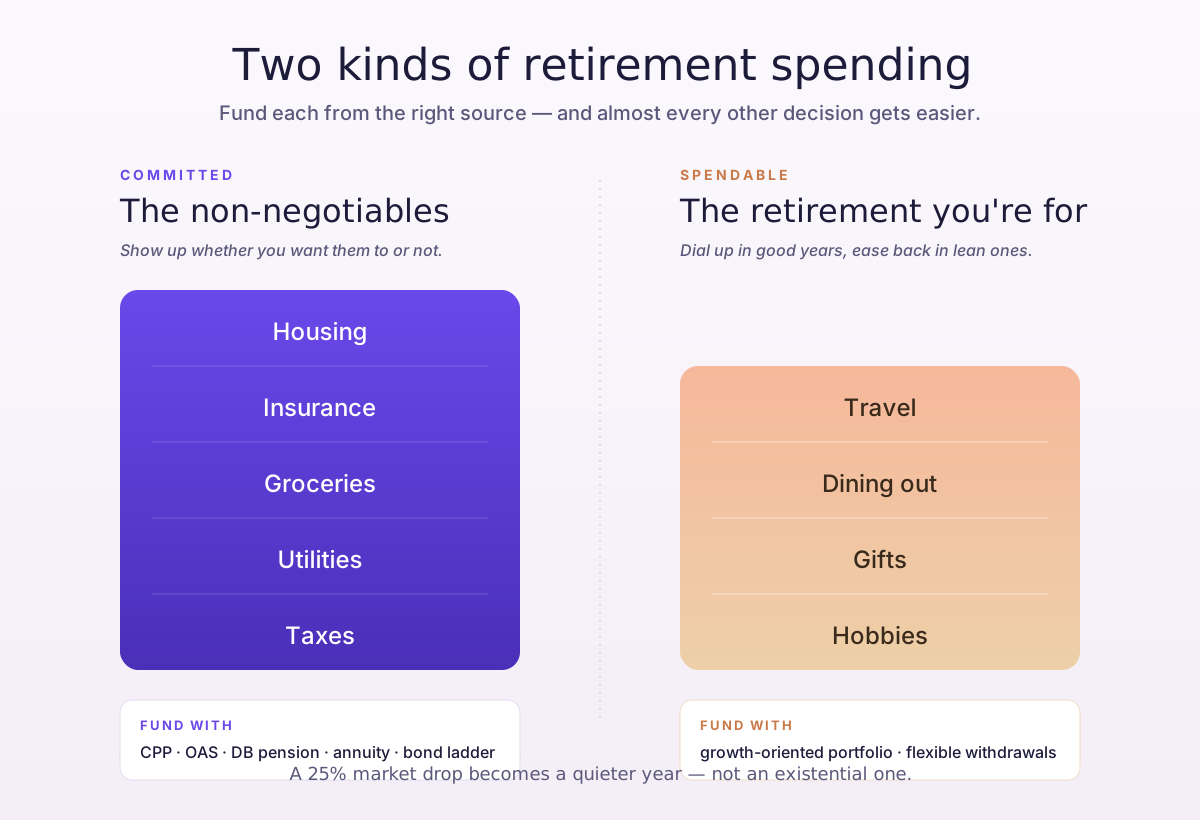
The reason this split matters so much is that it changes how much volatility you can stomach. If your committed expenses are fully covered by guaranteed income, a 25% drop in the market is uncomfortable but not existential — it just means a quieter year for the discretionary bucket. If everything is mixed together, the same drop forces you to choose between cutting the heating bill and skipping a trip. One of those is a sustainable retirement; the other is a stressful one.
Track first, project second
The temptation when planning for retirement is to project: "We'll probably spend about $70,000 a year." In my experience, projections that aren't grounded in actual tracked spending are off by 15–30%, almost always low. Memory edits out the boring stuff — the dental work, the new tires, the gift you forgot you bought — and those edits compound into a retirement budget that doesn't survive contact with reality.
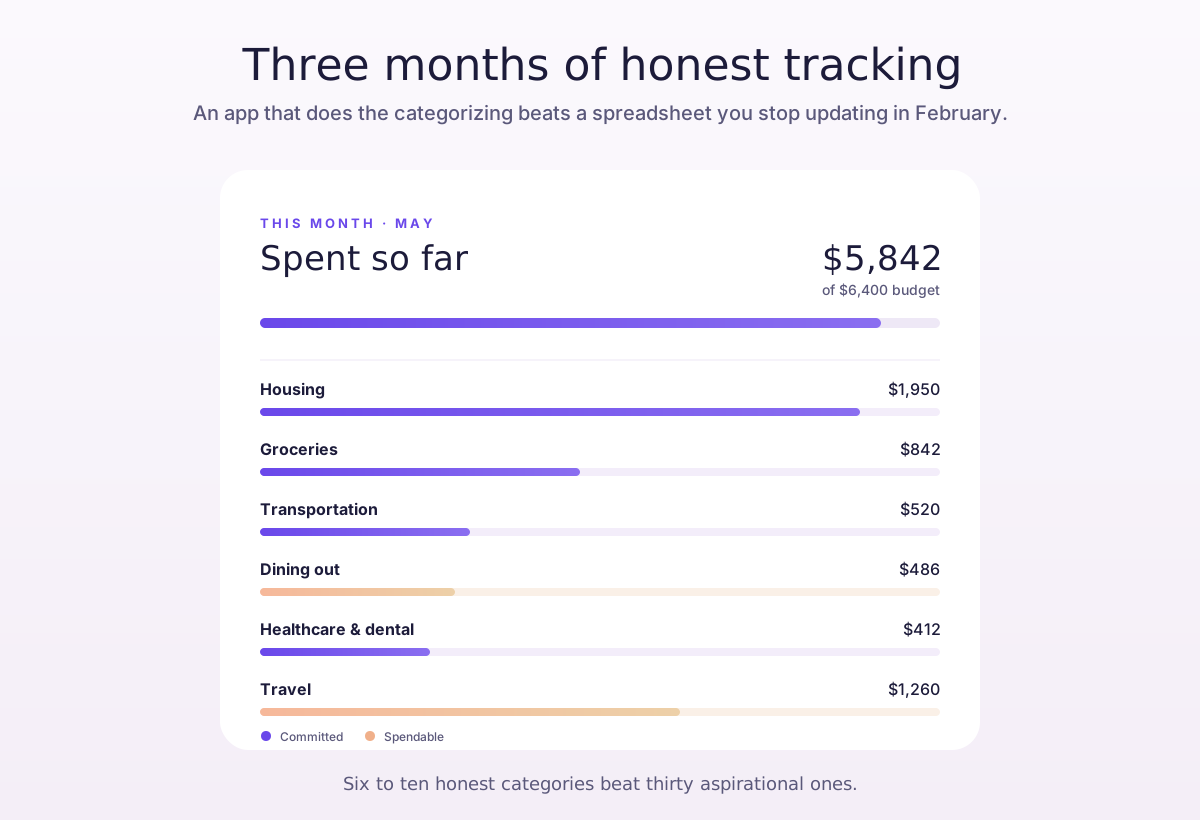
So before I'll let a client commit to a retirement date, I ask for at least three months of real tracking. Not estimating, not "we usually spend around" — actual transactions, categorized. The categories don't have to be elaborate; six to ten buckets is plenty. What matters is that the numbers are honest.
A good app makes this almost effortless. The two I most often recommend are Monarch Money, which connects to Canadian institutions and is excellent for couples who want to see joint and individual spending side by side, and YNAB, which is more opinionated and better suited to people who like the discipline of giving every dollar a job. A spreadsheet works too — for about six weeks, until it doesn't. Use whatever you'll still be using in month four.
What changes when you retire
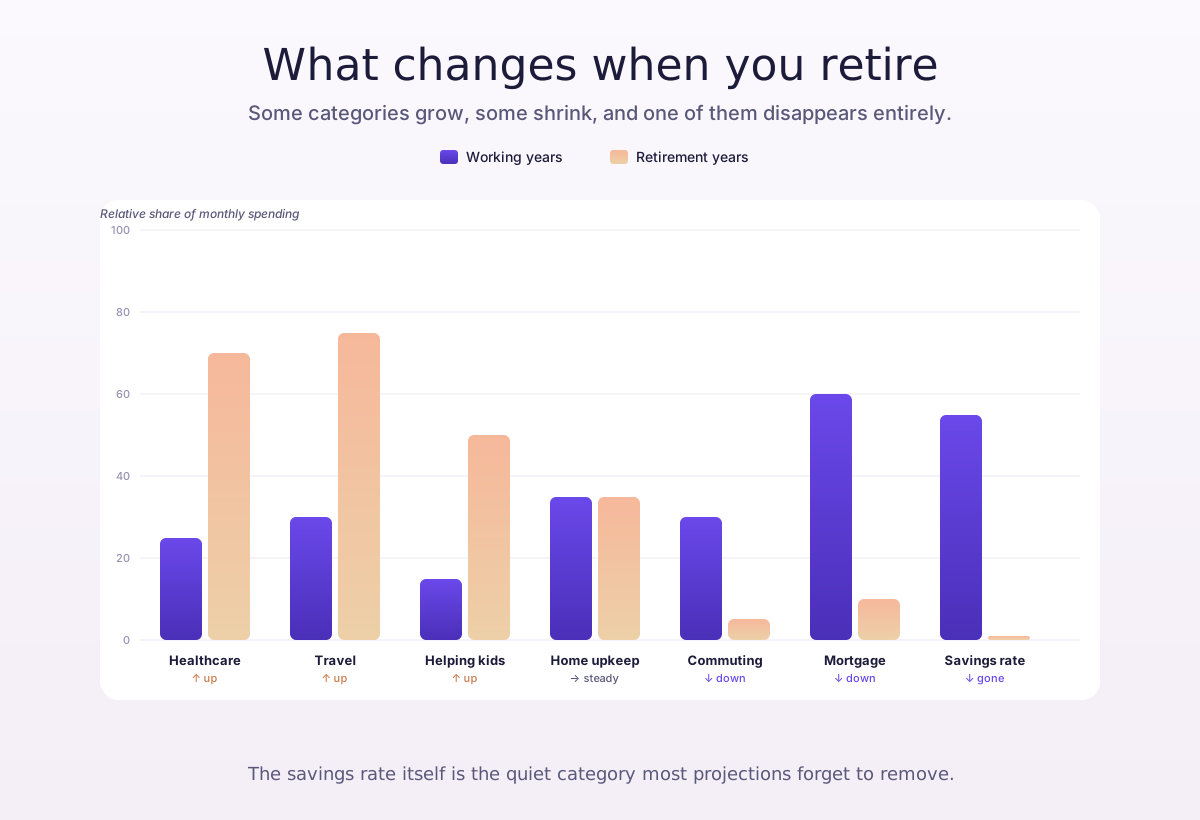
Some categories shrink in retirement, some grow, and a few appear from nowhere. The ones I see people consistently underestimate:
- Healthcare and dental. Once you leave an employer plan, prescription drugs, dental, vision, and physiotherapy come out of pocket or out of a more expensive private plan. Budget for it explicitly.
- Travel. The "go-go years" — typically the first decade of retirement — often involve materially more travel than the working years did. People plan for one big trip a year and end up taking three.
- Helping adult children. A down payment gift, a wedding contribution, school costs for a grandchild. Not strictly necessary, but extremely common — and almost never on the projected budget.
- Home maintenance. A roof, a furnace, a hot water tank — these don't honour your retirement date. Set aside an annual reserve, even if you don't spend it most years.
And the ones that genuinely shrink: commuting, the mortgage (often), work-related expenses, and — usually — the savings rate itself, which can be a meaningful share of your current "spending" that isn't really spending at all.
How this changes the rest of the plan
Once committed and spendable are mapped honestly, almost every other retirement decision gets easier:
- The right retirement age stops being a feeling and starts being a calculation. We can show exactly which year the committed expenses are fully covered by guaranteed income, and what gap (if any) the portfolio needs to fill.
- The right asset mix follows from how much of your spending is committed versus discretionary. More committed spending → more stability needed → more weight in bonds, GICs, or guaranteed income. The "60/40 because that's what people do" answer doesn't survive a real cash-flow analysis.
- The drawdown order — RRSP first, non-registered first, TFSA last — depends partly on your tax bracket but mostly on what your annual cash-flow need actually is, and how that need will change as CPP and OAS layer on.
- The CPP and OAS timing decision becomes much clearer once you know how much guaranteed income you actually need to cover the committed layer. Deferring CPP to 70 is a powerful longevity hedge, but only if your cash flow can comfortably bridge the gap.
Start where the data already lives
If retirement planning feels overwhelming, start small: open your bank and credit card statements from the last three months, total each major category, and write down what you find. That single hour of work is genuinely more valuable than another retirement calculator estimate, because it's the only number in the whole plan that's actually yours.
Once that's in front of you, the conversation shifts from do I have enough? to what do I want this money to do? — and that's a much better question to retire into.
If you'd like help mapping your cash flow and building the rest of the plan around it, book a complimentary consultation and we'll walk through it together.
Read next
More essays you may find useful.

RRIF first? Non-registered first? It depends on tax bracket smoothing, OAS clawback, and what you want to leave behind. A practical framework for the order in which to draw down each account in retirement.

Deferring CPP to 70 is almost always the better math — a guaranteed 8.2% lift for every year you wait past 65 — yet most Canadians still take it at 60. Here's why emotion keeps beating the spreadsheet, and when taking it early is actually the right call.

Shay Steacy shares what she learned when a family friend became unable to make decisions—and why the practical details of being a Power of Attorney matter long before a crisis.
Get the next post in your inbox.
We're publishing more essays like this one. Drop your email and we'll let you know when the next one goes live.